Prepared Hope as Peace-Building: From Whole-Person Presence to Whole-Systems Care
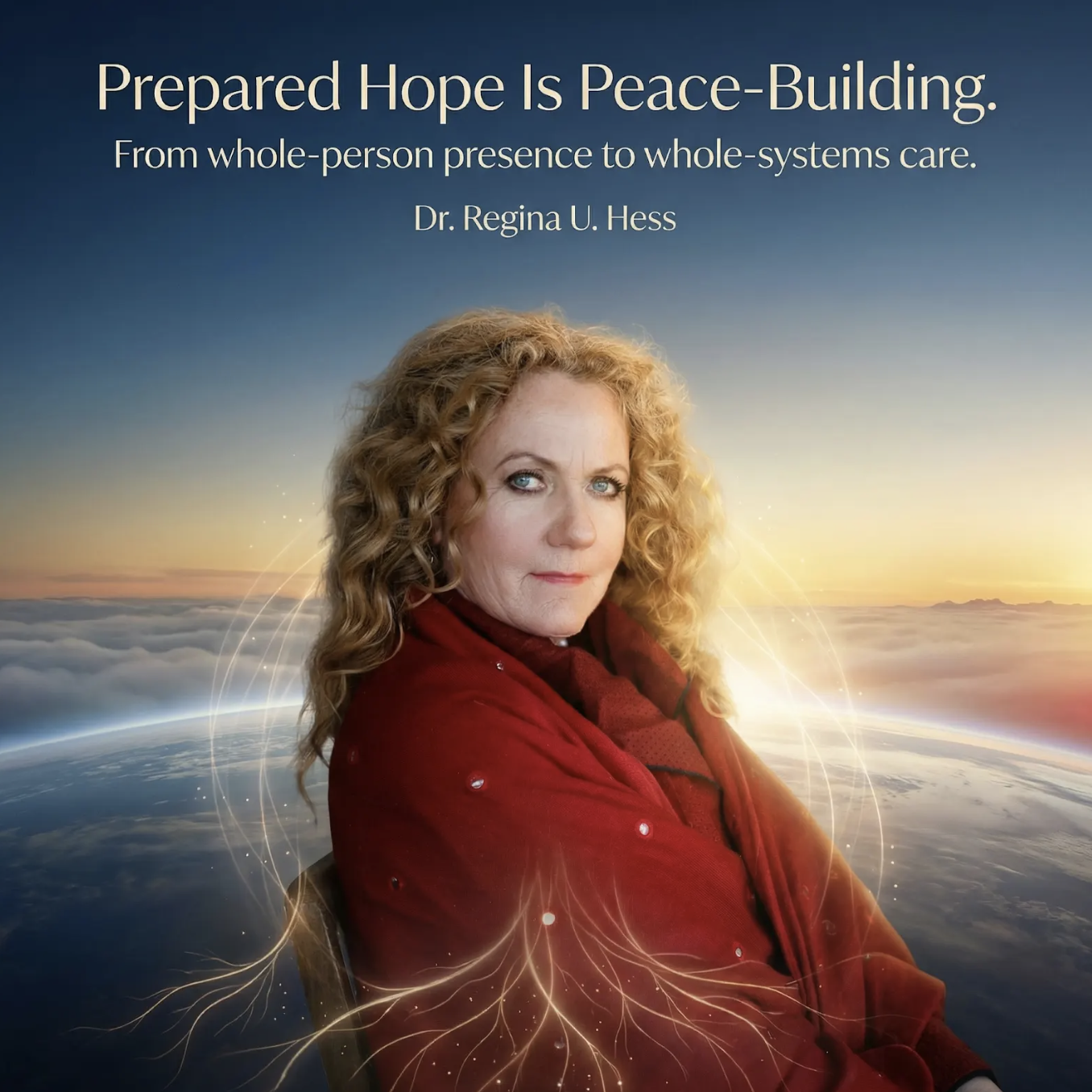
At a time when many people feel the world tightening under conflict, climate disruption, social fracture, and accelerating uncertainty, one question becomes quietly decisive: what kind of human presence supports life, protection, and wise action now?
Peace-building begins before policy. It begins in orientation, in tone, in disciplined attention, and in the quality of response a person brings into a family, a team, a community, and a wider field of service.
From whole-person presence to whole-systems care.
This is one of the central contributions of transpersonal leadership. It asks not only how a person heals, but also how a person becomes a stabilizing, life-affirming force in a larger field of crisis, change, and possibility.
Optimism as a Mature Stance
Optimism is often misunderstood as denial, passivity, or spiritual bypassing. I understand it differently. Mature optimism is a disciplined stance of life-serving orientation. It does not deny crisis. It refuses collapse into helplessness. It asks how positive intention can be joined with embodied action.
Research suggests that dispositional optimism is associated with better physical health outcomes and more adaptive coping patterns over time (Scheier & Carver, 2018; Rasmussen et al., 2009). This does not mean that optimism alone is enough. It means that orientation matters. The way people hold possibility influences perseverance, recovery, agency, and the willingness to act.
In times of global tension, this matters profoundly. A positive attitude is not the end point. It is the beginning of a pathway. It creates the inner conditions for steadier action, wiser choices, and less reactive participation in collective life.
Preparedness as a Form of Peace Service
Preparedness is one of the clearest ways to become part of solutions.
The United Nations Office for Disaster Risk Reduction defines preparedness as grounded in sound risk analysis and connected to early warning systems, contingency planning, coordination, evacuation arrangements, public information, training, and field exercises, all supported by institutional, legal, and budgetary capacities (United Nations Office for Disaster Risk Reduction [UNDRR], n.d.-a). The Sendai Framework further emphasizes understanding risk, strengthening governance, investing in resilience, and enhancing preparedness for effective response and recovery (UNDRR, 2015/2019).
Preparedness, then, is not fearfulness. It is care in organized form.
It is part of becoming useful to the whole. It is part of reducing preventable harm. It is part of peace-building because it protects life before conditions worsen.
Trauma-Informed Leadership in a Time of Crisis
My work has long included trauma, disaster intervention, protection, and preparedness. From that perspective, peace-building cannot remain only philosophical. It must be embodied, practical, and responsive.
The World Health Organization states that nearly all people affected by emergencies experience psychological distress and that mental health and psychosocial support should be integrated into preparedness and disaster risk reduction efforts (World Health Organization [WHO], 2025). WHO Europe also highlights the importance of training, coordination, and community engagement in responding to mental health needs during emergencies (WHO Europe, n.d.).
This is deeply relevant to leadership. A leader in today’s world needs more than vision. A leader needs the capacity to regulate under pressure, communicate clearly, reduce panic, strengthen trust, and help transform fear into coherent response.
Transpersonal leadership contributes here by linking inner development with outer responsibility. It supports the movement from wounded reactivity toward relational responsibility. It helps cultivate a person who can remain present without becoming passive, and active without becoming destructive.
From Positive Intention to Positive Systems Change
Positive intention matters. Yet intention alone does not change systems.
Systems change requires translation into structure, coordination, and repeated action. OECD work on resilience stresses that future shocks demand investment, improved coordination and cooperation, and whole-of-government and whole-of-society approaches (Organisation for Economic Co-operation and Development [OECD], 2023). This aligns with what many practitioners already know: good outcomes do not arise from isolated good wishes. They require preparation, relational trust, and organized follow-through.
In this sense, optimism becomes credible when it takes form. It becomes a checklist reviewed. A crisis plan updated. A skill learned. A conversation held. A structure strengthened. A community better prepared.
This is where whole-person practice meets whole-systems responsibility.
A Weekly Practice of Prepared Hope
For this week, I invite a simple three-step reflection and action.
Pause and ask: where in my life is preparedness asking for form?
Choose one concrete action: update an emergency contact list, organize important documents, review a health or communication plan, strengthen a local support connection, or learn one trauma-informed response principle.
Then join the act with conscious intention. Let it become a gesture of care for the greater good, not merely a private task.
This is one way peace-building begins.
I hold this conviction clearly: we incarnate here on Earth in human form with the purpose of experiencing life, and that includes protecting, safeguarding, and guiding all life from the past toward the future. Nothing in a mature civilization should move toward harm of children, elders, those of special need, animals, plant life, or our homeland Earth embedded in the cosmos.
That is part of the vision and mission of Birthing an Ancient Future, Multidisciplinary Council of Peace-Builders.
The question for this week is simple and demanding: are you reinforcing the problem, or becoming part of solutions?
Dr. Regina U. Hess, Ph.D. (NL/PT)
Visionary Founder/Director – Birthing an Ancient Future – Multidisciplinary Council of Peace-Builders
Clinician, psychotherapist, shamanic practitioner, author, researcher, educator
References
Organisation for Economic Co-operation and Development. (2023). Ready for the next crisis? Investing in health system resilience. OECD Publishing.
Rasmussen, H. N., Scheier, M. F., & Greenhouse, J. B. (2009). Optimism and physical health: A meta-analytic review. Annals of Behavioral Medicine, 37(3), 239–256.
Scheier, M. F., & Carver, C. S. (2018). Dispositional optimism and physical health: A long look back, a quick look forward. American Psychologist, 73(9), 1082–1094.
United Nations Office for Disaster Risk Reduction. (2015/2019). Sendai framework for disaster risk reduction 2015–2030.
United Nations Office for Disaster Risk Reduction. (n.d.-a). Preparedness.
World Health Organization. (2025, May 6). Mental health in emergencies.
World Health Organization Europe. (n.d.). Tackling mental health in emergencies.